
Healing and hurt
And the objects that help

Dear friends,
There used to be a website titled thenicestplaceontheinter.net — while that website is gone now, I think the responses in this Substack are a good alternative. Every week, I look forward to reading your responses to the prompt. As always — thank you for your generosity and responses. For those of you who haven’t contributed, or don’t regularly read the comments: even reading them uplifts the heart. And, you never know, you might be moved to write yourself.
My question and prompt this week concerns healing.
Perhaps like me, you have grown weary of the commodification of healing. Working in a post-conflict zone for years, I heard some give assurances of healing, which occasioned both concern and resistance in me — we’ve all seen too many people promote resolutions that don’t adequately consider those who’ve been ravaged by war. And, on the other side of my caution, when I hear myself (or someone else) say “I’ll start the task once I’ve healed from this-or-that trauma,” I find myself thinking that the delay is a “model obstacle” — something designed to justify delay, a set of conditions so perfect they’re guaranteed never to arise.
I am not a cynical person, but I do find myself suspicious of easy healing. Not because I don’t like the idea, but because much of what brands itself as healing has turned out otherwise. I don’t think many of the proponents of healing projects are poorly intentioned; I just am cautious about promises that can’t be fulfilled. It’s safe to say I have conflict about healing, even though I sincerely hope we can heal from our conflicts.
All of this to say is that I was overwhelmed by Richard Scott’s poetry collection That Broke Into Shining Crystals. Richard lives in London, is a former opera singer, and this is his second collection of poetry. Trauma informs the collection — much of it features a speaker who has survived the violence of childhood abuse. The first section of the book has our speaker in art galleries, looking at the still-life paintings: a life is stilled by violation, Richard says. He speaks of how, in the gaze between survivor and art object, a living testament can be found: to time’s arrest and to a canvas that seems to breathe with vitality. Can the still canvas make a still life live? There is something akin to praise-and-rage in Richard’s extraordinary poems.
Richard’s mother works with crystals, and the final section of his book — from which the collection takes its title — honours crystals, those precious stones made as a result of intense pressure.
I interviewed Richard last year, and this week, we released the interview as part of Poetry Unbound in Conversation. While the background of this interview is childhood trauma, the interview itself does not dwell on details. The interview examines language, art, crystals and — impossibly, and more brilliant than a diamond or ruby — the emergence of healing. No past is denied in this vision of healing of Richard’s, rather a present where art, looking, language, and attention are uplifted. Nothing is easy in this, but much is shown in his luminous poems.
Like many of us, I have lived through terrible abuses. I am interested in flourishing. But I am resistant to slick pathways of so-called healing art; bad examples of that bother the already bothered. At times during the interview, I found myself overwhelmed by the clarity of Richard Scott’s relationship to art, and how looking — at paintings, at language, at crystals — was a looking that also looked out and up and through and around. The vision and attention of his poems is a beautiful thing.
Friends, the question for you this week is this: What object helped you heal?
There is no need to share too much of the background details (the internet is a complicated space for sharing too much information). But if you have it in you to share something of what object helped you in your search for hard-made-hard-won-hard-sought healing, I would love to hear it. Healing is not a one-time thing: we are all joined in saying that some days, we are capable of newness, but other days, the old pattern returns. This, too, is a powerful thing — noticing the seasons, rather than thinking that time is a single thing.
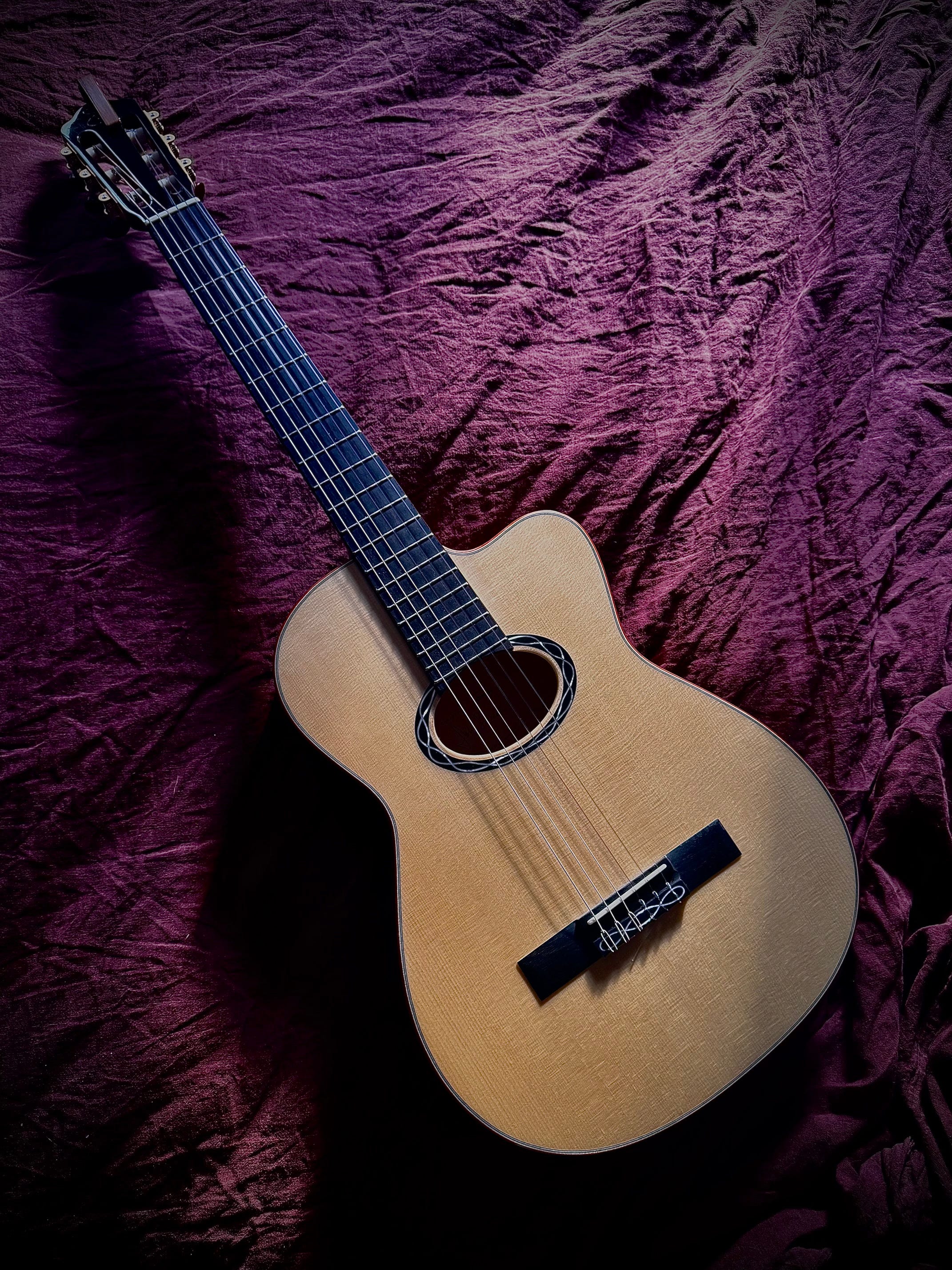
The guitar helped me. Holding it sometimes felt like an embrace, and playing it made music come back to me, through me, from me and in me. To be far from a guitar feels like an impoverishment in me. When I had little money, I’d repair broken strings myself, and my childhood guitar sometimes had blood-stained strings. I loved them and tuned them, and made them do things I didn’t know I could do. The reasons why I needed harmony are predictable and private. The attention to music has shaped my writing life.
I’ll see you in the comments, friends, with those stories of healing objects.
PS: Friends, I have a new book (Love Between Men) coming in September and I’ll be writing a bit about that book in Substacks throughout August. Pre-orders are the name of the game in the bookworld these days, so if you have the inclination to place a pre-order, I’d appreciate it enormously.
The Latest from Poetry Unbound
You can also listen at poetryunbound.org or wherever podcasts are found.
Poetry in the World
A list of my events: Online and in the U.S. (Santa Fe, NM; Frenchtown, NJ; Cambridge and Stockbridge, MA) and England (Kettering)
August 9–13, Santa Fe, New Mexico
I’m leading a four-day intensive workshop at Modern Elder Academy called “Poetry as a Common Language”. We’ll read, write, and discuss poems on finding and deepening connection. (For more information, click on the date heading.)
August 27–30, Kettering, England
I’m absolutely delighted to be returning to this year’s Greenbelt Festival, a gathering of arts, activism, and belief in England. (For registration info, click on the date heading.)
I’ll be leading evening worship alongside Nadia Bolz-Weber and Doug Gay as part of the Festival of Preaching, beginning at 5:30 p.m. GMT. (For registration info, click on the date heading.)
October 1, Frenchtown, New Jersey
Join me at Frenchtown Bookshop for a conversation and book signing, beginning at 6:30 p.m. (For more info, click on the date heading.)
I’m leading a virtual craft intensive on poetry and desire through Poets House, beginning at 6 p.m. ET. (For more info, click on the date heading.)
I’m delighted to be joining Ellen Bass’s wonderful Living Room Craft Talks Series for a discussion of the poetry of eros, beginning at 12 p.m. ET. (For more info, click on the date heading.)
November 2, Cambridge, Massachusetts
I’ll be reading alongside Susan Stewart as part of the Blacksmith House Poetry Series, beginning at 8 p.m. (For more info, click on the date heading.)
I’m leading a virtual course on lyric address through Arvon, beginning at 7 p.m. GMT. (For registration info, click on the date heading.)
December 18–20, Stockbridge, Massachusetts
I’m leading a retreat on poetry and prayer at the Kripalu Center for Yoga and Health. (For more info, click on the date heading.)
Michelle Penn and I will be reading together in a virtual event with Café Writers, beginning at 7:30 p.m. GMT. (For more info, click on the date heading.)
Tomorrow marks the milestone of 15 months since my husband died. Since then I have taken most of his clothes to the Good Will store, but cannot yet surrender one of his shirts. A year ago I wrote 3 haiku about 3 special objects that help me live with the hurt.
Though you are gone, the
sleeves of your wool shirt wrap your
arms around me still.
Only you know the
joy in the small wooden box
you made just for me.
Your eyes twinkle in
a picture from long ago.
I smile in return.
I've gone through a six year period in which I've lost two siblings and several close friends in a variety of sudden, traumatic ways (suicide, disease, heart failure, tragic accidents). My beloved dog (a springer/lab mix) was a steady support throughout it all, and then she died too. An artist friend made a necklace for me depicting my dog jumping over the moon: the necklace is silver, the moon is gold. Reeling from so much complex grief, I put the necklace on and have rarely taken it off again since. It represents all my lost loved ones, as well as my dog, symbolising how closely I carry them all with me as life goes on. I've heard it said that you don't really "heal" from grief; you learn to carry it more lightly. I carry my grief in silver and gold.