
Looking
and being looked at

Dear friends,
I loved reading your many-more-than-13 replies to the Wallace Stevens’s “Thirteen Ways of Looking at a Blackbird” last week — thank you.
Today I want to uplift the work of the poet Yousif M. Qasmiyeh, both of whose books are brilliant. I wrote an essay about a poem of his, “Writing the Camp,” for the first Poetry Unbound book in 2022. Since then, he’s published another book (Eating the Archive), which I was honoured to blurb.
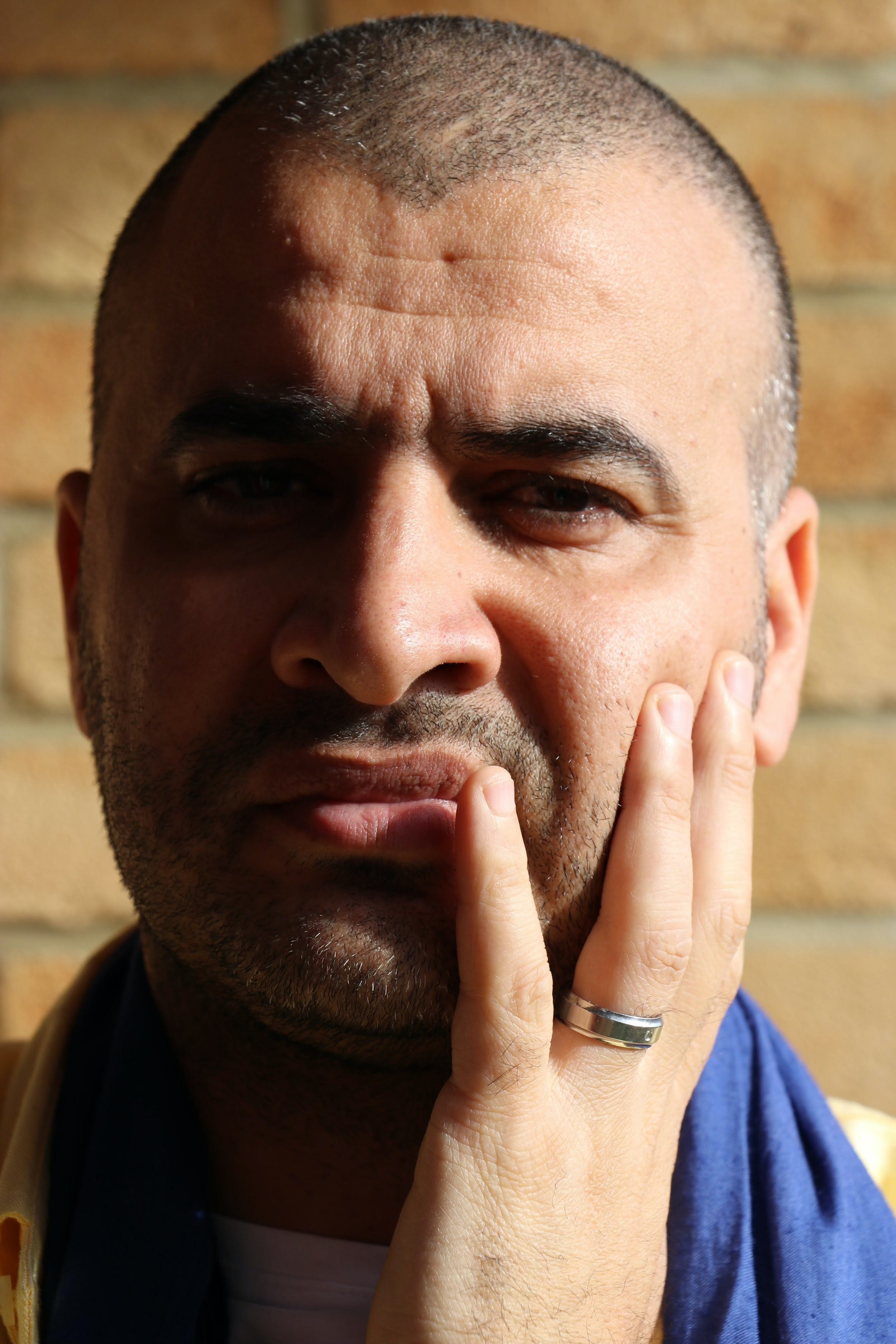
However, for our Substack today, I want to go back to a poem from his first book. Yousif is a poet, scholar, and translator, based now in England, who was born and grew up in the Baddawi refugee camp in northern Lebanon. Located near the city of Tripoli, it was established in 1955 for Palestinian refugees.
The entire camp is one square kilometre, and its population is close to 18,000. In the years since it was established, it has expanded up, not out. Yousif’s mother was born as her parents fled in 1948, and she’s lived her whole life in the camp, marrying and becoming the mother of 11 (sadly, Yousif’s father has died, and it is in honour of his father that he adopted the middle initial M).
It is in this context that this poem, from Writing the Camp (Broken Sleep Books, 2021), unfolds:
Anthropologists
I know some of them.

Some of them are friends but the majority are enemies.

Upon the doorstep you observe what they observe with a lot
of care.

You look at them the way they look at you, curiously and
obliquely.

You suddenly develop a fear of imitating them whilst they
imitate you.

You worry about relapsing into one of your minds while
sharing mundane details with them.

Sometimes I dream of devouring all of them, and just once
with no witnesses or written testimonies.

All of us wanted to greet her.

Even my illiterate mother who never spoke a word of
English said: Welcome!

After spending hours with us, in the same room, she left
with a jar of homemade pickles and three full cassettes with
our voices.
I interviewed Yousif a number of years ago for the Corrymeela podcast, and I asked him about this poem. His own words explore it best:
“Of course, on the one hand we acknowledge some of the work — the important work — that anthropology has, has done, but I also, in fact, try to discern and to critically observe how these individuals come to our places with their ready-made theories and we’re there to be mainly used as supporting evidence … And so through ‘Anthropologists’ I wanted … to say that my illiterate mother — and here I’m stressing the adjective ‘illiterate’ —in fact, was able to utter a word in English, in order to host and in order to host openly … [H]ospitality is something that normally people who are in need can offer, because they can share, and this is ... in fact much more generous than offering in abundance what you already have.”
As you see, one of the directions of Yousif’s criticism is in the employment of power. His poem looks back at that and those which look at. Look at whom? People whose stories are told without them telling their stories, perhaps. I have thought about this poem ever since I read it. The stark nature of the language. The simple attention to what is far from simple. The question of power and time and language and hospitality.
The question for this week is simply to ask: What challenges you in the poem?
There are many who can identify with the need to narrate their own stories, yes. But in the political climates of today, I think we need to practice the muscle of saying “I have changed” — what does the poem challenge you to say?
Poetry in the World
A list of events: Online and in Australia (Melbourne, Queenscliff, Sydney), Ireland (Cork, Dublin, Listowel), and the US (Chicago, Indianapolis, Memphis, Seattle)
April 3, Seattle, Washington, US, and online
I’ll be giving an evening talk at Saint Mark’s Episcopal Cathedral. Registration is needed, and you can find information here.
April 7, Indianapolis, Indiana, US
I’ll be at Butler University as part of its visiting writers series. No need to register, and you can find the details here.
April 9, Chicago, Illinois, US
In the afternoon, I’ll be offering — along with museum educator Marielle Epstein — a gallery tour at the Art Institute of Chicago, looking at how art and poetry invite us to be present to each other. You need to register, and you’ll find details here.
April 10 & 11, Memphis, Tennessee, US, and online
I’ll be back at Calvary Episcopal Church for two events: an evening interview on the first day and a midday sermon on the second day (the sermon will also be livestreamed). Both events are free to attend, and you can find details here.
April 26–27, Melbourne, Australia
I’m giving a two-day retreat on “Poems on Being with Each Other,” with the Small Giants Academy lovelies. Registration here.
May 2–4, Queenscliff, Victoria, Australia
I’ll be speaking at the delicious sacrededge festival. More info here.
May 7, Sydney, Australia
The marvelous Miriam of Poetica is organising a poetry reading in the evening. Get tickets here.
May 8, Sydney, Australia
I’ll be speaking in the morning at the Welcoming Cities Symposium. Registration here.
May 8–11, Melbourne, Australia
I’ll be speaking on the Saturday (May 10) of the Melbourne Writers Festival. Festival info here.
May 13–17, Cork, Ireland
I’ll be reading and conducting an interview at the Cork International Poetry Festival. Details here.
May 20, Dublin, Ireland
I’ll be reading at the International Literature Festival Dublin (ILFD). Information here.
May 29, Listowel, County Kerry, Ireland
I’ll be reading at Listowel Writers’ Week. Information here.
I remember this poem from both the podcast and the book... it is one that really has made me think. But, in reading the poem this time I was struck by this passage:
"After spending hours with us, in the same room, she left
with a jar of homemade pickles and three full cassettes with
our voices."
It just occurred to me that she left with much more than she gave... and how sad is that. Perhaps that is the flaw in "the hated anthropologists" that they always left with more than they brought. I am thinking of how often I, also, "leave with more than I brought" and it is not a pleasant thought.
In a time when it seems everyone is mostly out for themselves, can I challenge myself to be different?
Research conducted by academics in marginalized and oppressed communities (under the guise of adding to knowledge and understanding) has been extractive for far too long. This beautiful poem captures that so painfully: the anthropologist left with the gifts of pickles and people’s voices and stories. But what did the anthropologist give the poet’s family in return? “The opportunity to have their voices heard” is a common response, but can we honestly say that’s enough? The challenge to us is to move beyond this answer and work more deeply for equity and justice. Especially now.