
Looking
and looking at your looking

Dear friends,
While I’ve lived in cities most of my adult life, I grew up in the countryside. During covid, I spent a few years back in the countryside — although in the northwest of Ireland rather than the south coast of my childhood.
It was one of the periods when I wasn’t sleeping much, so I was often outside at 3 or 4 a.m., watching the slow light come up over the neighbouring field. A lifelong fan of the radio, I even found myself eschewing it in favour of the sounds of morning. There was a particularly virulent chaffinch who was desperate to find a mate. He’d sing from the top of a slender tree, and I could hear his song above all the others. And there were many of them: robins, wrens, blue tits, coal tits, song thrushes, blackbirds, jays, dunnocks, siskins, and even — oh glory for its low-throated husk — a bullfinch or two.
There were many other animals too. Once, outside at 3 a.m., I heard snuffling around my feet. I was sitting at a patio table and turned the light of my phone on to see what was alive near me. At my feet was a hedgehog, its spines glossy in the torchlight. There were two bats too, tiny ones. They’d swoop at dusk to feed on the insects. Of course, there were foxes and dainty, prancing squirrels. And a pine marten. And cows and sheep from the next-door farm.
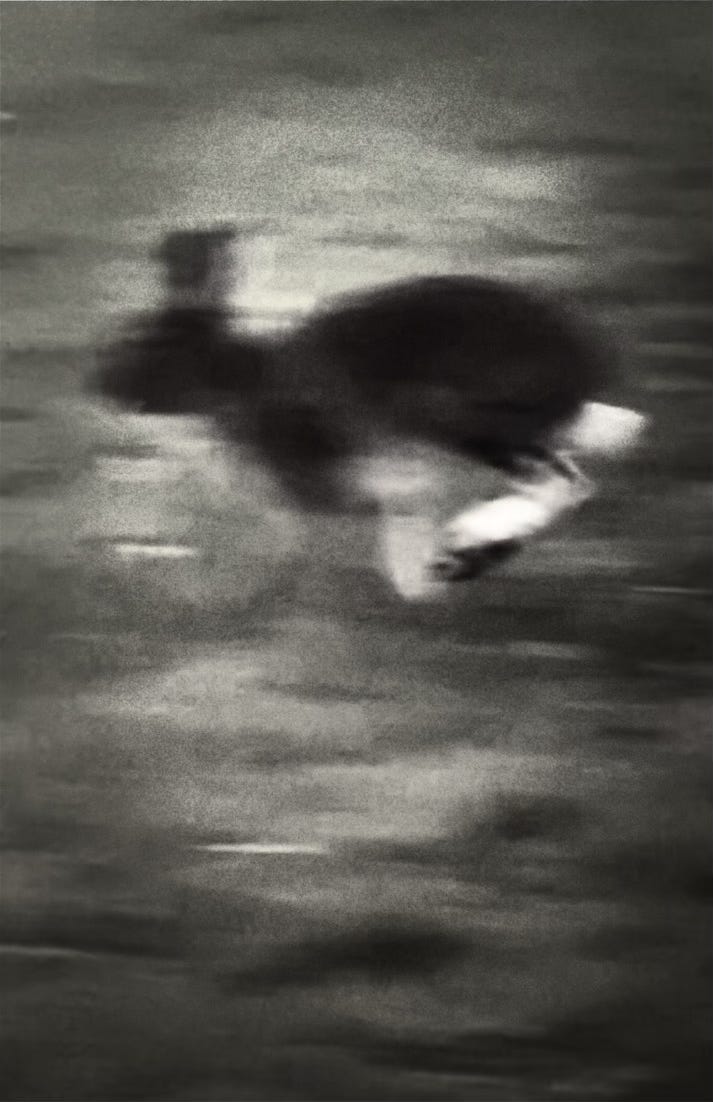
And hares. Hares. That’s what I want to talk about. Giorria is what we call them in Irish, the low-deer. A hare is to a bunny what a Harley is to a tricycle. Larger, they don’t burrow, their young are born fully formed, and they can reach speeds of over 40 miles an hour with their powerful hind legs propelling them. I adore seeing hares, and during those years, there were three generations of them that I’d see multiple times a day.
Once, I saw two leverets — young hares — move close to a blackbird. I have no idea why, but it looked like curiosity. The blackbird hopped back but not far. Another morning, two hares copulated in the field next door. Then they went about their morning routine, rummaging through the stems for things to eat. If I was lucky, I’d see a hare in the long evening, looking out over the field, its body mostly still but quivering, its ears never still, always turning, turning, turning for caution and alarm.
I say all of this, because I have recently completed reading Chloe Dalton’s magnificent book Raising Hare, which is about finding a lone leveret near her countryside house in England. The resulting connection with this extraordinary animal — what she learnt, how it changed her, how it changed how she saw the surrounding world — makes for compelling reading.
Chloe Dalton is a brilliant writer (I don’t know her; this is no favour for a friend). A foreign policy writer by profession, she writes with a precision that’s honed by poetry as much as research, science as much as reflection. She is committed to writing about the hare as it is rather than anthropomorphising it, and in the midst of this praiseworthy commitment, she writes with an intimacy and privacy that I found deeply moving. I started it one day and finished it the next.
To look at something is sometimes to seek to shape it. In Raising Hare, the subject of observation is as strange and as beautiful as you would imagine, and the writing echoes this. In being about one thing, the book is about many other things, and I learnt much about looking by reading this account. If you’re searching for something to read, this is utterly rewarding.
My question this week: What untame animal has affected how you look at things?
I’ll be offline for the next few weeks (on a writing residency in Maui — with my old friend Jayne — to finish a manuscript for a new book of poetry to be published in 2026), and I will keep an ear out for all your animals. There won’t be the usual letters from me, but there will be Sunday morning poems coming your way for the next few weeks through August 10. I look forward to being in touch when I’m back. In the meantime, find a copy of Raising Hare!
PS: Chloe Dalton’s website has some glorious photos and information about anti-hunting campaigns.
Poetry in the World
A list of my events: Online and in the US (Maui, and Honolulu, HI; Rhinebeck, NY; North Kingstown, RI; Stockbridge, MA) and the UK (Iona, Scotland)
July 30, Maui, Hawaii
I’m giving a reading at the Arts and Cultural Center. You can buy tickets here.
July 31, Honolulu, Hawaii
I’ll be giving a talk at the Honolulu Museum of Art as part of a residency with the Merwin Conservancy. Details here.
September 26–28, Rhinebeck, New York, and Online
I am leading a weekend retreat exploring “Strange Stories of the Bible” at Omega Institute. Expect strangeness, swearing, f**ked up stories of families, and literary brilliance. You can join in person or online.
November 14, North Kingstown, Rhode Island
Together with Sophie Cabot Black, I’ll be reading as part of Spencer Reece’s “14 Gold Street Series” Turn up — it’s free, it’s at 5:30 P.M. ET, and the location is here.
December 19–21, Stockbridge, Massachusetts
I’m leading a retreat called “Poetry of Peace” at Kripalu Center for Yoga & Health. More details and registration here.
June 27–July 3, 2026, Iona, Scotland
Krista and I will be leading a week of conversation (with some musical guests) on Iona, an island off an island off the west coast of Scotland. The Saint Columba hotel will be releasing information about it soon; sign up to that list here.
Birds, definitely. My mother was a complicated person living in much despair and anger and clearly overstretched with three children. On winter days with not a chance to send us away and outside, she would sit us in front of the window looking out into the garden, where she had spread all sorts of bird food on the snow, gave us a book with illustrations of birds and the task of identifying as many as possible with the promise of some sort of reward. We would sit almost motionless and silent for a considerable length of time and marked our sightings as required.
She died 25 years ago, in agony, and I am certain that she has come to me in the shape of a bird many times since. Only recently, a young hawk flew very low with a loud screetching noise above me as I cycled home, almost touching my helmet, and all I could say was, hi mum.
I love this early morning read. I am careful with insects, moths, ants, snails, slugs spiders etc. I move the snails and slugs across the gravel path. I help the fly or wasp trapped in my home find the exit. I talk to the ant roaming the porcelain sink. As much as possible I try not to interfere. I only rescue when necessary. I love saying good morning to the spider who loves in the corner cupboard. All life is precious, even the tiniest.