
Remembering the past
Remembering the future

Dear friends,
In Irish language classes growing up, we were taught that no composition could be complete without quoting old sayings. Hence, we spent time memorising and reciting seanfhocail—a word that translates nicely as “old words/sayings,” or perhaps “proverbs.” Many of them resemble sayings from other languages, for instance “is glas iad na cnoic i bhfad uainn” means “far away hills are green.” There’s one about choosing the right timing “ní hé lá na gaoithe lá na scolb” (“the windy day is no day for thatching”) that I love. Languages’ proverbs compose a lovely everyday poetry, but they also are a way of recognising that what guided a life centuries ago might also guide a life today.
The one in today’s photo is another favourite: “As cloch na cuimhne síolraíonn an todhchaí.” You could translate it as “from the stone of memory the future springs forth” or, to turn it around: “the future is borne by the stone of memory.”
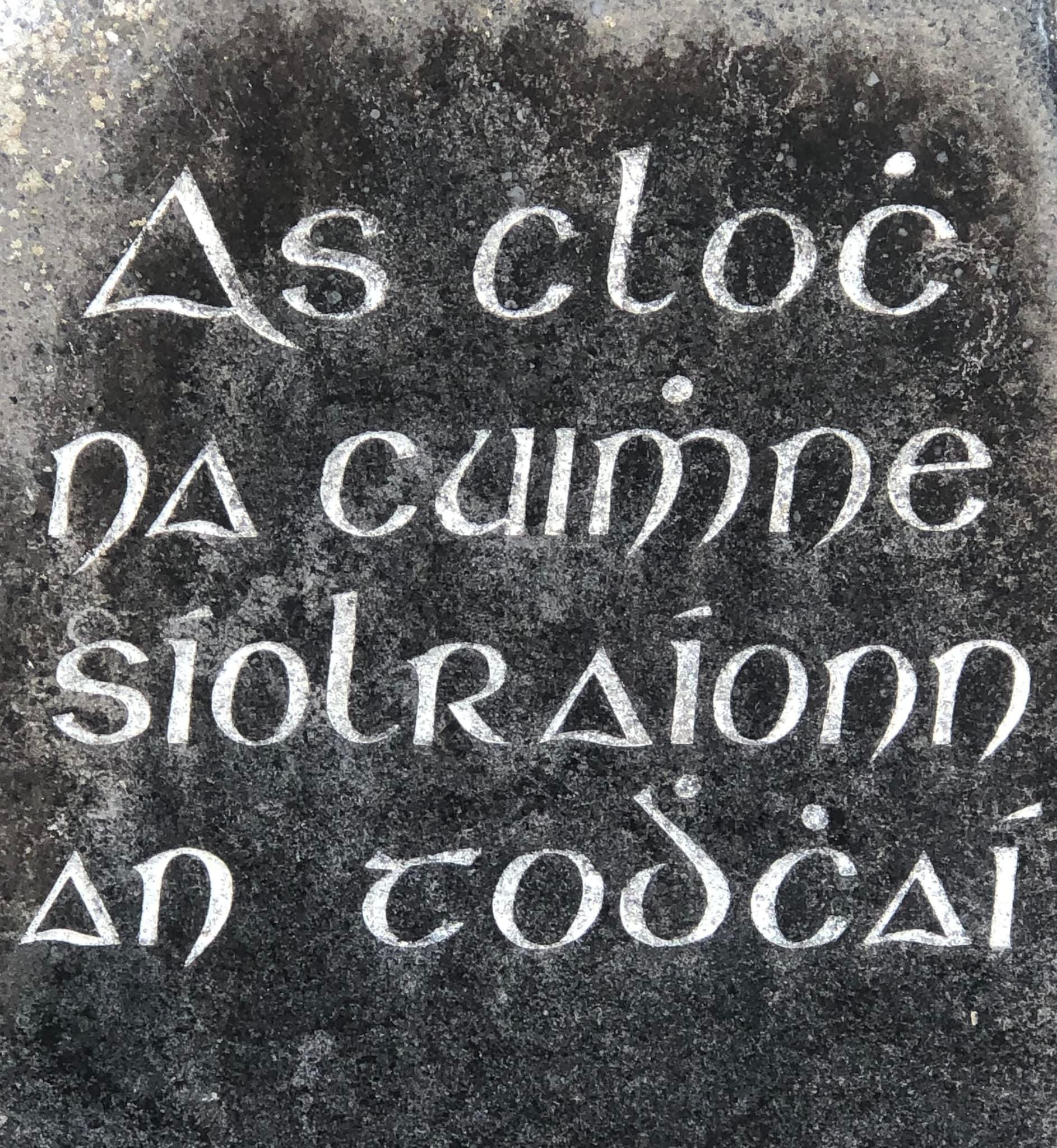
Memory is a personal and a political thing. For many years, the public process of peace, justice and reconciliation in the north of Ireland has approached—with trepidation—the complicated question of Remembering. There have been government appointments on questions of remembering, policy papers on it, proposals for civic and educational institutions on it. How the past is remembered may shape the future.
The future? I wonder. The future hasn’t unfolded yet, and anything can happen. But certainly we are in the present now. I sometimes think that the future is shaped on a moment of courage in the here-and-now, and those courageous, creative acts can perhaps open up the possibilities of something surprising. There’s another side to it too: shocks can open up the predictability of devastation. The hope is that courageous acts are veering toward a surprise that unfolds with something of increased safety, rather than decreased.
All of this leads me to an Emily Dickinson poem:
	The Past is such a curious Creature
	To look her in the Face
	A Transport may receipt us
	Or a Disgrace—

	Unarmed if any meet her
	I charge him fly
	Her faded Ammunition
	Might yet reply.
Emily Dickinson Sheet 89, 1872, FR 1273; J1203 from Emily Dickinson’s Poems: As She Preserved Them. Cristanne Miller (ed.), Harvard University Press, 2016.
In this exquisite poem, the past is alive (“Creature!”) with agency (“curious”) and to look at her (what is she—a cat? a person? a puma? a dragon?) something might happen—"a Transport,” or “a Disgrace.” Already in four lines, the present presence of the past is evoked as something that can cause a disruption, something stretched along the terrible arc between movement and shame.
And then the second stanza: you should not meet the past “Unarmed.” This was written—or, at least, collected in one of Emily Dickinson’s poem-bundles—in 1872, in the decade after the American civil war. The past has “Ammunition” we hear, and it might “reply.” The past is not only curious, but it may be volatile. What’s the solution, should it be tamed? Should we protect ourselves from it? Should we try to learn from it? Certainly, it’s not quiet, and it might fight. Emily Dickinson doesn’t give easy proposals in her poem (understatement of the century).
Incidentally, in Cristanne Miller’s magnificent Emily Dickinson’s Poems: As She Preserved Them, the marginalia are preserved: those might be ways in which Emily Dickinson had previous (or future) versions of what a poem’s stanza could be, or it could be ED expanding the idea of a poem’s line. Relevant for us is that in the final two lines of this poem, some alternatives written by the Poet of Amherst are “Her Rusty Ammunition/Might still—destroy.” The power of these lines, and that devastating adjective “Rusty” stop me short every time.
Political communities are always in the process of remembering. Some will say “draw a line on the past and look to the future.” Others will say something akin to the phrase above, that the future depends on the capacity to remember. There’s probably a fruitful tension to be found in wisdoms from many approaches to the past, present and future. The past is alive, with barbs, and shames and truths, we hear in this poem.
I’m curious what Emily Dickinson’s poem evokes in you. I’ll look forward to seeing you in the comments.
Poetry in the World
A list of my events: Online and in the US (Manhattan, Brooklyn, and Rhinebeck, NY; Swarthmore, PA; Atlanta, GA; Cleveland, OH; Portland, OR; North Kingstown, RI; Chicago, IL; Stockbridge, MA; Notre Dame, IN) and the UK (Iona, Scotland)
September 21, Brooklyn, New York
Come find me at the Brooklyn Book Festival in Brooklyn Heights. I’ll be in conversation with Cathy Linh Che, Aracelis Girmay, and Hafizah Augustus Geter on the 21st of September at 12:00 P.M. Event information can be found here.
September 26–28, Rhinebeck, New York, and Online
I am leading a weekend retreat exploring “Strange Stories of the Bible” at Omega Institute. Expect strangeness, swearing, f**ked up stories of families, and literary brilliance. You can join in person or online.
October 10, Swarthmore, Pennsylvania
I’ll be discussing “Poetry and Openness” with Megan McFayden-Mungall, Isadora Caldas, and Vivian Ojo at the 2025 Annual Conference of the Peace and Justice Studies Association at Swarthmore College. You can purchase tickets for the conference here.
October 15, Manhattan, New York
Join me for a lecture alongside Episcopal Bishop Marianne Budde at St. Thomas Church. You can register for this free event here.
October 18, Atlanta, Georgia
I’m leading a retreat day called “Poetry, Prayer, and Place” at The Cathedral of St. Philip. Learn more about the retreat and register here. Tickets at reduced rates are available.
November 6, Cleveland, Ohio
I’ll be visiting Case Western Reserve University to have a conversation with Michele Tracy Berger. Registration details can be found here.
November 8, Portland, Oregon
Come say hello to me at the Portland Book Festival. For pass information and the complete author lineup, check out the festival’s website.
November 14, North Kingstown, Rhode Island
Together with Sophie Cabot Black, I’ll be reading as part of Spencer Reece’s “14 Gold Street Series” Turn up — it’s free, it’s at 5:30 P.M. ET, and the location is here.
December 1, Cambridge, MA
I’m delighted to be reading with Martín Espada at the Blacksmith House Poetry Series on the 1st of December at 8:00 P.M. Admission costs $5 and can be paid at the door, more info here.
December 5–7, Manhattan, New York
I’m thrilled to be part of the Irish Poetry Festival at the Irish Arts Center in Manhattan; I’ll be doing two events: one paid and one free. Tickets and full details here.
December 11, Chicago, Illinois
I’m honored to be reading alongside E. Ethelbert Miller at the 27th Annual Peace Concert. Learn more about the free event and get a ticket here.
December 19–21, Stockbridge, Massachusetts
I’m leading a retreat called “Poetry of Peace” at Kripalu Center for Yoga & Health. More details and registration here.
April 23, Notre Dame, Indiana
I’ll be giving the keynote for a symposium at the Raclin Murphy Museum of Art. Event details here.
June 27–July 3, 2026, Iona, Scotland
Krista and I will be leading a week of conversation (with some musical guests) on Iona, an island off an island off the west coast of Scotland. The Saint Columba hotel will be releasing information about it soon; sign up to that list here.
Probably because I’m a trauma therapist and because I stay committed to my own work, I see how important it is to be ready (armed) for when the past sneaks into our present through dreams and unexpected moments of being triggered/reminded of what’s unhealed. Sometimes conscious. Sometimes not. The beauty of good poetry, music, beauty, and good trauma work is how when the past sneaks into present, when we’ve developed internal and external supports, we have a chance to heal and integrate. Not so true when we are “unarmed”and at the mercy of reflexive trauma responses and the unhealed wounds from our history.
Thank you Padraig for your fine piece on Emily Dickinson.
Each week I am uplifted by your post.
This time I respond with something of my own:
FUTURE ODE
Ω κόσμου ήταν εύκολο τότε, ένας απλός χτύπος της καρδιάς.
The world was easy then; a simple heartbeat,
George Seferis; Love's Discourse
The world is simpler now,
That Nature's all but gone.
A glowering moon,
Orange with simmering fury
gives way to sickening daylight.
Grandiloquent Oak looks out
For what might yet remain,
Beyond the manstained chemical fields,
Finding the hidden wren in the hedgerow.