
Today is history …
… making the future

Dear friends,
Midlife! Stories of sorrow, of joy, of change, of wonder, of complication, of levity. Yes yes yes. Thank you for all that you shared last week.
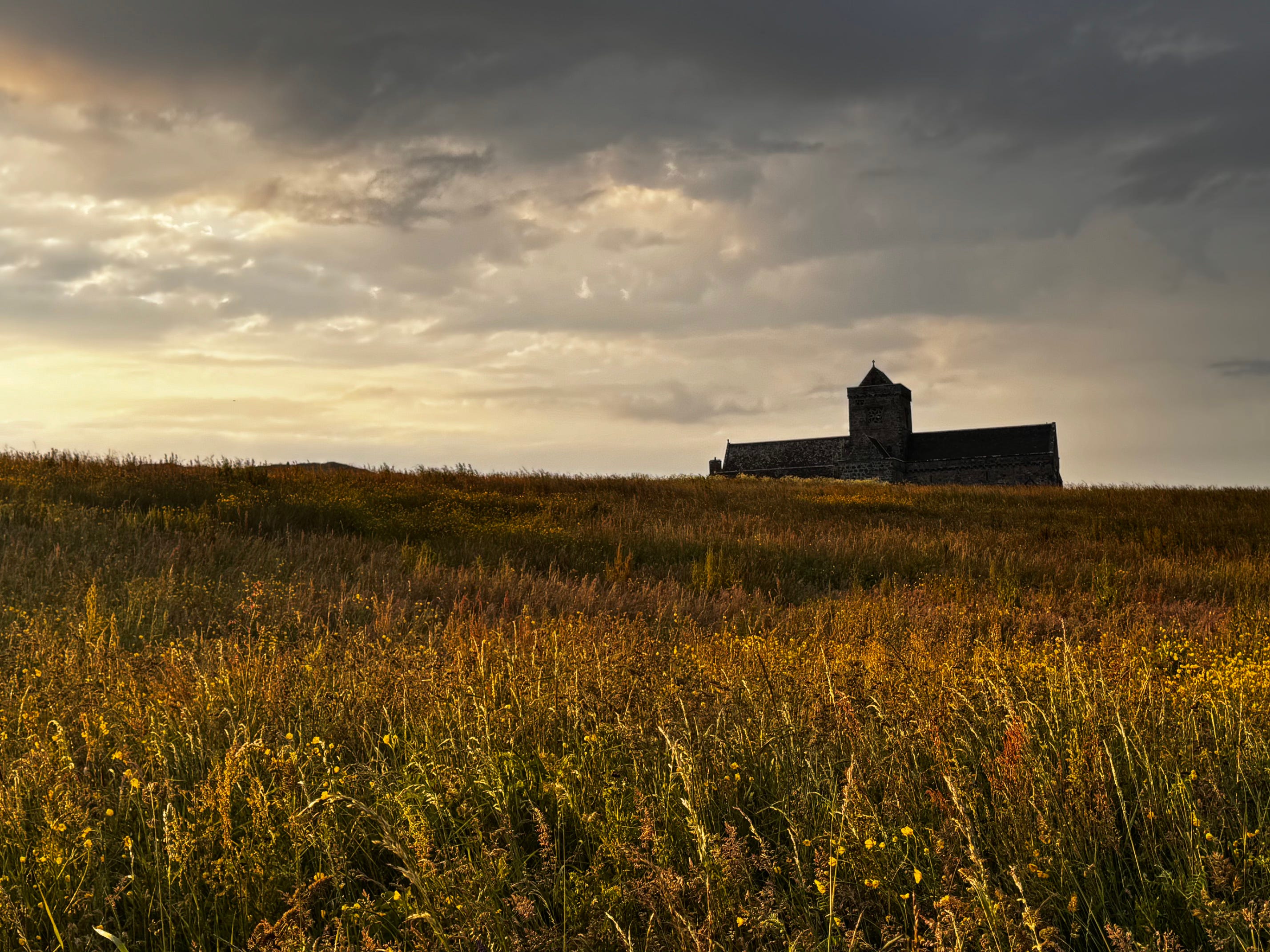
I have just been on the Scottish island of Iona for a week (rain, sunshine, birds — including corncrakes — an abbey, people, music, poetry, discussion, sunshine, late bright evenings, boat trips). It was a beautiful place to be, a place — like all places — where time marks itself all around. Saint Columba came to Iona from Ireland in the late 500s, establishing a monastic community.
An abbey was built in the 1200s, and after a refurbishment 100 years ago, stands, hosts, and prays by the water. The nearby island, Mull, is a few hundred million years old, whereas Iona is something like two billion years old. Time and time and time. One morning, writing, I looked out the back window and saw a dormouse, a small yet big-eared sleepy mouselet (the “dor” of “dormouse” comes from the French “dormir” for sleep). The dormouse’s life is small compared to mine, and there it is, looking for something to eat on an island that’s two billion years old. Me too.
All of this is a subtle way for me to invite you into one of my favourite games as the prompt for this week: If you were to wake 150 years from today, what would be the top-five things in what-will-then-be-history you’d research?
For instance, in no order, I’d want to inquire of whatever Wikipedia will be:
What’s happened with the reunification of Ireland?
What’s happening with ocean levels?
How did Israeli and Palestinian safety and sovereignty develop?
Why is Bob Dylan still alive?
Who are the contemporary poets? And which poets from the early 2000s are still read?
I mean also, I’d want to find out when aliens made themselves known to us, #obviously. And I wonder what USA400 will be. (Happy USA250 to all who USA btw.)
I suppose the stream under these musings is to wonder what I can do today to contribute to the future where such histories will be probed. In this way, we might be midwives of a future by making something today. Time can contract and expand in the space of a line of poetry. Working with men in a prison poetry project, one of them said something like “The years fly by / but it’s a lifetime till lunch.” And Marie Howe makes this happen in her poem “My Mother’s Body”, where — recalling the fact that her own mother was 24 years old when she gave birth to Marie and that Marie was nearing 50 when writing the poem — she writes: “I’m old enough to be that girl’s mother”.
I’ll see you in the future, friends. Make it something.
The Latest from Poetry Unbound
You can also listen at poetryunbound.org or wherever podcasts are found.
Poetry in the World
A list of my events: Online and in the U.S. (Santa Fe, NM; Stockbridge, MA) and England (Kettering)
August 9–13, Santa Fe, New Mexico
I’m leading a four-day intensive workshop at Modern Elder Academy called “Poetry as a Common Language”. We’ll read, write, and discuss poems on finding and deepening connection. (For more information, click on the date heading.)
August 27-30, Kettering, England
I’m absolutely delighted to be returning to this year’s Greenbelt Festival, a gathering of arts, activism, and belief in England, beginning. (For registration info, click on the date heading.)
I’ll be leading evening worship alongside Nadia Bolz-Weber and Doug Gay as part of the Festival of Preaching, beginning at 5:30 p.m. (For registration info, click on the date heading.)
I’ll be leading a virtual craft intensive on poetry and desire through Poets House, beginning at 6 p.m. ET. (For more info, click on the date heading.)
I’m delighted to be joining Ellen Bass’ wonderful Living Room Craft Talks Series for a discussion of the poetry of eros, beginning at 12:00 p.m. ET. (For more info, click on the date heading.)
November 2, Cambridge, Massachusetts
I’ll be reading alongside Susan Stewart as part of the Blacksmith House Poetry Series, beginning at 8:00 p.m. (For more info, click on the date heading.)
December 18-20, Stockbridge, Massachusetts
I’m leading a retreat on poetry and prayer at the Kripalu Center for Yoga and Health. (For more info, click on the date heading.)
Upon waking in 2176, I would love to find out:
* What was it that got people to stop burning fossil fuels and instead rely upon the sun and wind for power?
* How did people decide to make boundaries on artificial intelligence, to be able to use it for the good and still rein it in?
* How are people researching the past, when people didn’t have nearly as much time to make poetry and art?
* Who was the last trillionaire?
* Where can I find some ice cream?
I often struggle to think about the future right now, stuck as I am – as we all seem to be – in an endless limbo present of rehashed violence and separation but the two most important questions that come to mind to ask of such a future would seem to be: Are we still here? Do we still love each other?
In the meantime, these lines from the young Pakistani-American activist and writer Ayisha Siddiqa are a balm - they come from her poem “On another panel about climate, they ask me to sell the future and all I’ve got is a love poem”.
…
“What if the future is soft and revolution is so kind that there is no end to us in sight.
Whole cities breathe and bad luck is bested by a promise to the leaves.
To withstand your own end is difficult.
The future frolics about, promised to no one, as is her right.
Rage against injustice makes the voice grow harsher yet.
If the future leaves without us, the silence that will follow will be an unspeakable nothing.
What if we convince her to stay?
How rare and beautiful it is that we exist.
What if we stun existence one more time?...”