
Upon this rock
“the rock is here, is extremely visible and extremely, oh, eloquent”

Dear friends,
I loved reading about what you do with your rage (and other strong feelings) over the last week. What tempests we can be. In every group facilitation I participate in or run, I feel the power of sentiment in the room and wonder how — given that we will never “solve” everything; nor is it the job of group facilitation to do so — we can harness the dynamic for something creative, both for individuals and as a collective. Such work is as much about my failure as any achievement. We all bear so much.
So, thank you.
In your Poetry Unbound feed, there’s now an interview with the great Canadian poet Don McKay. (We featured his poem “Neanderthal Dig” on the podcast last year.) When I interviewed him a few years ago (in fact, coincidentally, it’s exactly two years ago today: 17 May 2024), he spoke of some great conversions in his life, one of which was to geology. This has influenced his poetry, his relationship to landscape, his free time, his intellect, and much more. He lives these days in Newfoundland, from where he writes poetry, writes letters, participates in community gardening, and calls around to his neighbour’s house to join in a Zoom interview by me.
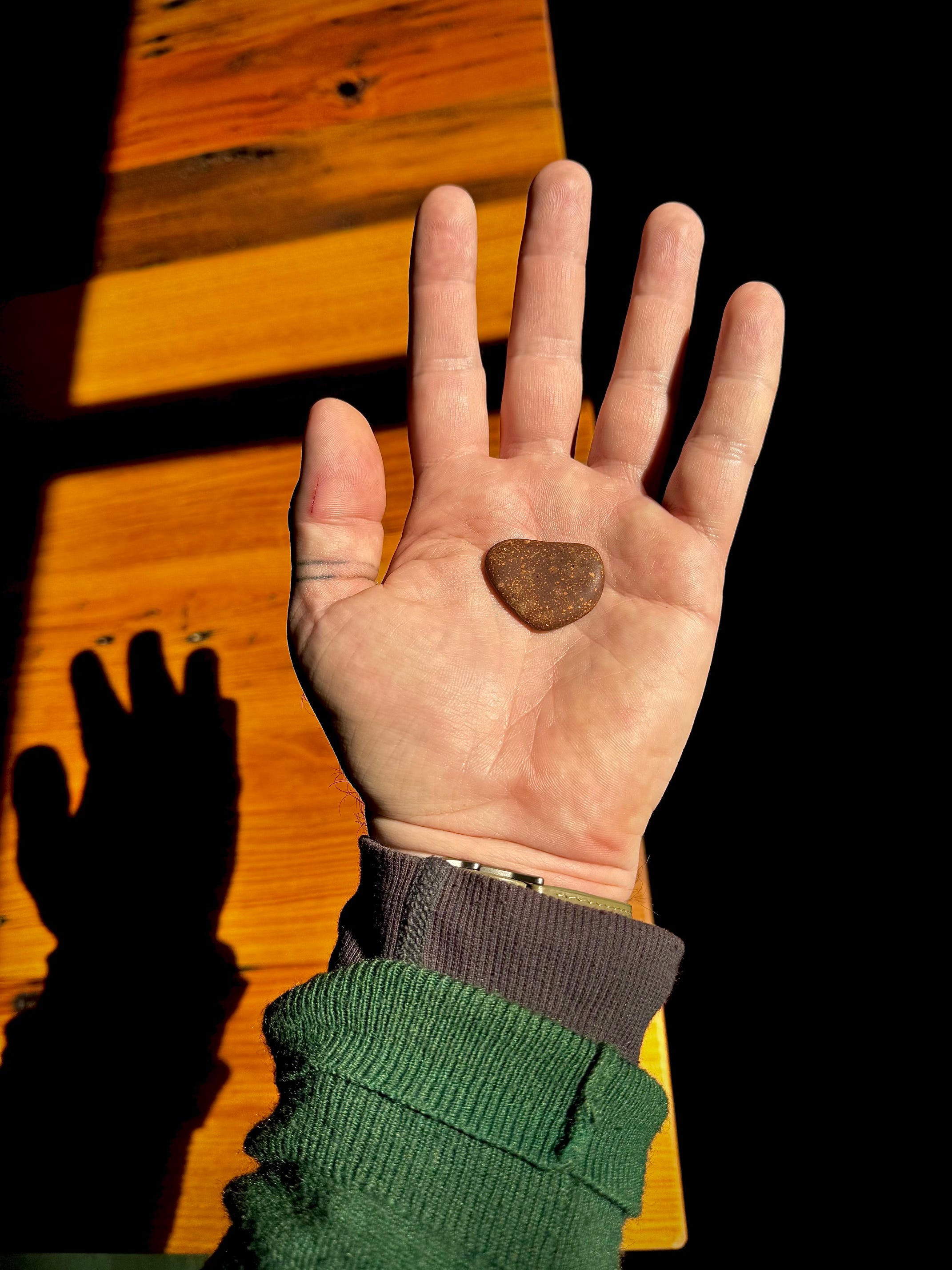
Don pays attention to time through geology — you can hold a stone in your hand or touch a cliff or a rock, and be in touch with something that makes the span of even a long human life seem like a mote of dust. At one point in the interview, he says:
“Newfoundland is like opera for geologists. It’s … fantastic, partly because thanks to the glaciers, which the Ice Age, which scraped all the topsoil off and put it, deposited in the ocean as the Grand Banks, so the rock is here, is extremely visible and extremely, oh, eloquent. And so you have way more access to that temporal, that deep time than than other places. I know, once I get started into rocks, you have to shut me up. So, go ahead. Tell me.”
I did not shut him up, and he spoke of rocks in a way that has deepened my appreciation since I interviewed him a few years ago. I keep thinking of that descriptor he used: “eloquent”. “Face like a stone” is a common enough phrase, implying zero communication, but Don McKay helps us hear that stones have always been shouting out, always been noisy about their histories, always been communicating and changing.
With all of this in mind, my question this week is about rock. What is a rock that you’ve got a memory with?
I can think of a few: a small reddish rock I’ve carried for a few years, even though I’ve forgotten where I got it and why I carried it; a time walking around Uluru with my friend Cheryl, feeling the pulsing energy of that sacred site in the heart of Australia; my father clinging to a rock in order not to swept away by waves; the rock a boy in school threw at me from a great distance and which — I wish I did not know his skill — hit me; and the primal need I feel, when back in Ireland, to touch rock, to be in contact with the land my forebears walked on and which, even now, supports the earth in which they’re buried.
I’ll look forward to reading your words, friends. And enjoy the episode.
The Latest from Poetry Unbound
Poetry Unbound in Conversation — Don McKay
You can also listen at poetryunbound.org or wherever podcasts are found.
Poetry in the World
A list of my events: Online and in the U.S. (Rhinebeck, NY; Santa Fe, NM) and Scotland (Iona)
May 31–June 5, Rhinebeck, New York
I’m leading a six-day workshop at the Omega Institute. We’ll read and examine poems and also write and discuss our own. I’d love to see you there. (For more info, click on the date heading.) And if you can’t join it, you might enjoy Orion’s Environmental Writers’ Workshop, taught by a team that includes past Poetry Unbound poet Michael Kleber-Diggs. Learn more about the Environmental Writers’ Workshop — which takes place at Omega from June 14–19 — here.
June 27–July 3, Iona, Scotland
Krista and I will be leading a week of conversation (with some musical guests) on Iona, an island off an island off the west coast of Scotland. It is filled, but if you want to be on the wait list, you can email the Saint Columba hotel by clicking on the title just above here. (For more info, click on the date heading.)
August 9–13, Santa Fe, New Mexico
I’m leading a four-day intensive workshop at Modern Elder Academy called “Poetry as a Common Language”. We’ll read, write, and discuss poems on finding and deepening connection. (For more information, click on the date heading.)
I’ll be leading a virtual craft intensive on poetry and desire through Poets House, beginning at 6 p.m. ET. (For more info, click on the date heading.)
I live in some of the oldest mountains, where mind-bogglingly ancient peaks have been rounded by so much time and weather. I have always felt it is the deep bedrock here that helps write the story of our lives… it sends me to other places to meet other rocks.. and pulls me back again to tell about it. Ken Wilber once used a rock as an example of something that will not respond to you if you speak to it and I felt so unimpressed by his inability to relate. I agree with Don McKay about the eloquence of rocks. I’ve never once addressed a rock that did not address me back.
I’ve heard that if you really want to commit to something, tell a rock about it. I once told a pleasingly smooth chunk of sooty basalt that I wanted to be free from the chokehold of my father’s abuses, and we are still in this good conversation.
I once carried seven large stones in the back of my pick up truck--it was like divination, to see their configurations after each drive. I had a mysterious incident in that truck, in which I did not die, and not long after that, I carried these stones on a canoe, with my beloved, and dropped them near the center of an 800ft-deep lake. I return to them in my mind often, to learn about those deep, impossibly deep places.
When I am in need of grounding, I find some exposed bedrock and sit with my back to it. I imagine my bones are remembering something from the stone, or that the stone is listening to me through my bones.
I can’t wait to hear everyone’s stone stories here!
Hello Pádraig and friends,
Thank you all for another week of generous, thoughtful writing. Thank you, Pádraig, for this prompt and for Don McKay's voice in my ears. His description of rocks as "extremely visible, extremely eloquent” and the way they give us access to deep time struck a chord with me.
The first thing that came to mind from your prompt is a memory from an essay I wrote for Family Stories a few years back about meeting my brother Miles. My brother Miles was adopted before me, though he's younger, as an infant. I arrived on the scene years later at the age of 8.
Here's the extract:
My adoptive parents brought me into the house before the placement was even finalized. During that first full day and night with them, I was certain that this would only be trouble. I didn't trust a soul and had seen from experience that adults were not to be trusted.
Miles took me by the hand and showed me the house. Then the two of us slipped out the front door, sat on the cracked front stoop for a minute, where I stayed silent, pouting. After a few minutes of side-eying me, he pulled me over to the side of the house, where he showed me some rocks.
"This is mica, and they call this 'fool's gold,' and this is my favorite sandstone," he said.
"What's so great about sandstone?" I asked, kicking at the grass.
He took a pale red piece of sandstone, picked up another larger rock and broke the soft red rock into pieces, crushing it with the harder rock. He ground it down as if he were using a mortar and pestle.
Then he picked up the hose, filled a plastic bucket with water, and returned to me. He cupped some water in his hand and let a few drops fall onto our mound of red rock dust. Then, he rubbed it between his fingers to form a kind of paste. He then — very seriously — drew lines on my cheeks and forehead, after his own, and said: "Now we're ready for anything. War paint!"
That red sandstone held everything Miles was trying to tell me. You belong here. I've got you. We're in this together. He called it "war paint”, borrowing language from childhood imagination, not understanding its weight, but what he meant was simpler and deep. We're a team now, we're protected, we're ready. The rock became a bridge between two kids who didn't know how to trust anyone yet, and somehow, through dust and water and ritual, we began. Don McKay was right, rocks are eloquent. That pale red sandstone spoke for my brother when he couldn’t find words himself.